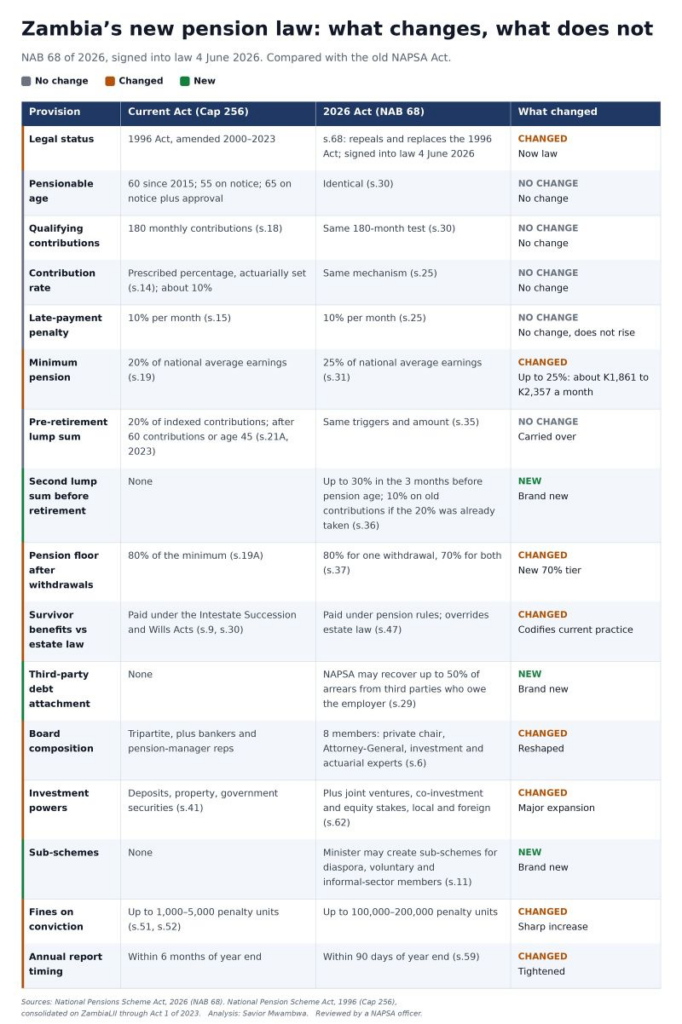
Zambia has a new pension law.

The President signed NAB 68 of 2026 into law on 4 June. It repeals and rewrites the 1996 NAPSA Act. Most of the noise is about things that are not changing.
Retirement age stays at 60 (it moved from 55 back in 2015). The contribution rate stays at 10%. The 20% early withdrawal has been law since 2023. Read the headlines and it looks like a big reform. Read the law and a lot of it is housekeeping.
The changes that matter are quieter.
A second lump sum. In the three months before you retire you can take up to 30% of your contributions. The full 30% if you never touched the 20%. If you did, it is 10% on the old money and 30% on the new. Take both and your pension floor drops to 70%. The real expansion of early access, and a quiet invitation to retire on less.
Enforcement. The 10% monthly late penalty does not rise. What is new is reach: NAPSA can take up to half an employer’s arrears straight from a bank or client that owes them. Fines on conviction climb to as high as 200,000 penalty units.
Investment. The old law kept NAPSA in deposits, property and government paper. The new one lets it co-invest and take equity stakes, at home and abroad. Exactly the long-term domestic capital we keep saying Africa needs. It is also members’ retirement money. Who picks the projects? How is it protected? What happens when an investment fails? The law grants the power and leaves the answers to regulations that do not exist yet.
Coverage. New sub-schemes can bring in diaspora Zambians, voluntary contributors and informal workers. In a country where most people work outside formal payroll, that could reach furthest of all.
The minimum pension also rises from 20% to 25% of national average earnings, about K1,861 to K2,357 a month.
The law is signed, but it is still a frame. The numbers that hit your pocket will sit in the statutory instruments the Minister issues next.
When those regulations drop, read them. That is where the pension you actually retire on gets decided.