
Investors Are Voting Too.
Ceaser Siwale – Executive Chairman: Pangaea Holdings
On Thursday, Zambians go to the polls. But for those of us in the capital markets, the more interesting manifesto isn’t from any party, it’s the one the Chamber of Mines published in election week: stronger exploration incentives, support for mineral processing and value addition, expanded power generation, tax reform, and relief on export duties for concentrates. It is, in effect, a memo to whoever occupies State House on 14 August. The investor question this week is not really “who wins?” but “what survives the winning?” More than $10 billion in mining investment has arrived since 2021, copper trades near $14,000 a tonne, up roughly 40% in a year, and the national ambition is to triple output to 3 million tonnes by 2031. Capital of that scale is wagered on the durability of policy across electoral cycles, not on a personality.
The ballot itself
The politics, plainly stated: more than eight million registered voters choose a president under a two-round system. President Hakainde Hichilema of the UPND seeks a second term against Brian Mundubile of the PF-anchored Tonse Alliance and thirdly Fred M’membe of the Socialist Party with his allies. Nothing in this note assumes an outcome, and that is the point, Zambia’s democratic credibility is itself a priced asset as it lowers the country’s risk premium in a way no investor-relations campaign could.
The copper arithmetic
Output rose 8% in 2025 to 890,346 tonnes from 825,513 tonnes, real progress, yet short of the 1-million-tonne marker once pencilled in, after a tailings failure at one operation and a weak year at another. That is how concentrated the base still is. Tripling from here is not a stretch goal; it is a re-founding of the industry, and the Chamber’s asks, exploration incentives, licensing reform so ground sits with developers who will drill it, value addition, dependable dispute resolution, are best read as its bill of materials. Vedanta’s return at Konkola, First Quantum’s expansions and Barrick’s reinvestment at Lumwana are the visible down-payments.
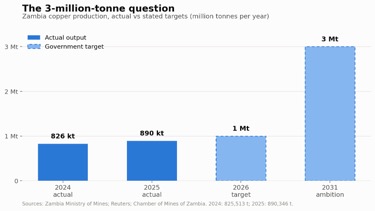
Actual output grew 8% year-on-year, but the 2031 ambition implies more than tripling from here.
The whole crown, not just the copper
Whoever wins inherits an economy in visibly better health than the one that defaulted in 2020: inflation at 6.5% in June, an eight-year low; a kwacha up around 16% against the dollar; a policy rate cut to 13.25%. The $1.7 billion IMF facility that underpinned the debt restructuring concluded in January, and talks toward a successor programme, targeted for late 2026, will be the first test of post-election continuity. But the crown is heavy. The 2026 deficit is projected near 5% of GDP against a 2.1% target, widened by election-year spending. Power is the industrial ceiling: mining expansion alone needs at least 2,000 MW of new capacity, while the hydro-dependent grid still forces blackouts and roughly $50 million a month in imports. If there is no implementation of an energy plan, there is no 3 million tonnes of copper and no 10 million tonnes of maizes by 2031.
Agriculture employs far more Zambians than mining ever will, this year’s ;aize harvest is expected up 28%, targeting 10 million tonnes, and the cost of living, not the copper curve, is the argument pressed hardest on the campaign trail. Miners, meanwhile, are being asked to lift domestic procurement from about 20% toward 40% of spend within three to four years: done well, local content builds the supplier base and political durability the industry needs; done clumsily, it becomes a compliance tax. A credible diversification story, agro-process-ng, energy, tourism, transit trade, is not a garish to the mining story. It is the hedge that makes it financeable.
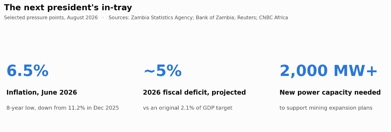
Disinflation is real; so are the fiscal and power gaps waiting on the winner’s desk.
Heavy is the head
The candidate who takes the oath inherits a copper price near record highs, a restored macroeconomic reputation and more than $10 billion of committed capital, and, in the same breath, a power deficit, a slipped fiscal target, an IMF negotiation, a cost-of-living electorate and reforms that take longer than a presidential term to pay off. Encouragingly, the deeper architecture, the 3-million-tonne ambition, a stable mining tax regime, the restructuring framework, commands something close to consensus across the political field. After Thursday, we at Pangaea will watch five markers:
- the tone of the IMF successor talks;
- the first budget’s treatment of the deficit and ZESCO reform;
- movement on licensing and the concentrate export duty;
- power deals reaching financial close; and
- the seriousness of local participation and local-content implementation.
Those will tell us more about Zambia’s next five years than the margin of victory ever could. On Thursday, Zambians choose a president. The day after, the president must choose Zambia’s word, to citizens, creditors and investors alike. The good news, for Zambia, is that the crown has rarely been worth more.
Disclaimer: This article is general commentary for information purposes only. It is not investment, legal or tax advice, nor an offer or solicitation in respect of any security. It does not express support for, or opposition to, any candidate or political party. Readers should obtain independent professional advice before making investment decisions.
